Deep inside the permafrost of a remote Arctic mountain, the Global Seed Vault has long served as humanity's ultimate insurance policy against agricultural catastrophe. But as climate change accelerates, scientists are looking beyond the Arctic Circle to an unlikely new fortress for biodiversity: the slopes of Mount Everest.
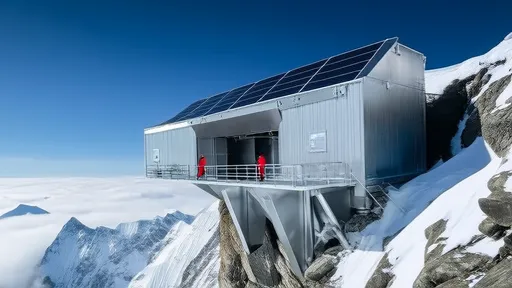
The newly established Everest Seed Bank, perched at 5,300 meters above sea level, represents a radical shift in conservation strategy. Unlike its Arctic counterpart which relies on artificial refrigeration, this high-altitude repository leverages nature's own freezer - the permanently frozen Himalayan terrain - to preserve samples of the world's most vital crops.
"What began as a backup plan has become a necessity," explains Dr. Mingma Sherpa, lead researcher at the Nepal Agricultural Research Council. "We're seeing seed banks in tropical regions struggle with power failures during extreme weather events. The Arctic vault remains secure, but we need distributed resilience."
The logistics of operating at such altitudes are daunting. Each seed shipment requires helicopter transport and sherpa teams trained in cryogenic handling. The facility itself, built into the mountainside with triple-reinforced concrete, can withstand earthquakes up to magnitude 9.0 - a critical feature in one of the world's most seismically active regions.
Climate models suggest the Everest location could maintain subzero temperatures for centuries even under worst-case warming scenarios. "The Khumbu Glacier's ice may retreat," says glaciologist Dr. Emma Richardson, "but the permafrost layer here extends nearly 200 meters deep. It's nature's perfect deep freeze."
Indigenous knowledge played a crucial role in selecting the site. Local Sherpa communities had preserved potato varieties in high-altitude caves for generations. "Our ancestors understood these mountains could keep things alive through time," says village elder Ang Dorje. "Now science is learning from that wisdom."
The vault currently houses over 250,000 seed samples, with particular emphasis on heat-resistant crop varieties. Among the most precious deposits: drought-tolerant rice strains from Vietnam and a rare wheat cultivar from Pakistan that can survive both flooding and extreme heat.
Security combines ancient and modern solutions. The entrance, carved to resemble traditional Buddhist stupas, hides biometric scanners and motion-sensitive cameras. More importantly, the remote location itself provides protection - the treacherous Khumbu Icefall acts as a natural barrier against unauthorized access.
Funding comes from an unusual coalition of governments, tech billionaires, and Buddhist organizations. The Dalai Lama personally endorsed the project, calling it "compassionate pragmatism" during a 2022 blessing ceremony attended by scientists and monks alike.
Not everyone supports the initiative. Some agricultural economists argue resources would be better spent helping farmers adapt now rather than banking seeds for hypothetical future disasters. "This is climate defeatism dressed up as preparedness," contends Dr. Rajiv Patel of the Food Policy Institute.
Ongoing research at the site has yielded unexpected benefits. The extreme conditions are helping scientists identify ultra-resilient plant traits. Recent experiments with barley seeds exposed to Everest's intense UV radiation showed remarkable mutations that could lead to breakthroughs in crop hardiness.
As the Arctic vault faces its own climate challenges - thawing permafrost required a $20 million upgrade in 2019 - the Everest model may inspire similar projects. Ethiopia plans a high-altitude seed bank in the Semien Mountains, while Chile is exploring Andean locations.
The team in Nepal emphasizes this isn't about abandoning Svalbard's global vault, but creating a network of ecological arks. "One lock won't protect humanity's food future," says Dr. Sherpa. "We need multiple keys, scattered across the planet's last resilient places."
At dawn, when the first sunlight hits the vault's mirrored exterior, the structure disappears into the mountain's glare - both monument and secret, waiting for a future we hope never comes.
By /Aug 18, 2025
By /Aug 18, 2025
By /Aug 18, 2025

By /Aug 18, 2025
By /Aug 18, 2025
By /Aug 18, 2025
By /Aug 18, 2025
By /Aug 18, 2025
By /Aug 18, 2025

By /Aug 18, 2025
By /Aug 18, 2025
By /Aug 18, 2025
By /Aug 18, 2025
By /Aug 18, 2025
By /Aug 18, 2025
By /Aug 18, 2025
By /Aug 18, 2025
By /Aug 18, 2025
By /Aug 18, 2025

By /Aug 18, 2025
